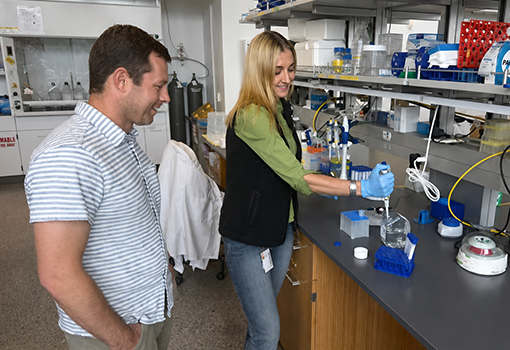
During his first year as a PhD student at UC Santa Barbara, Andrew White had trouble finding his place.
White had arrived with a bachelor’s degree in biochemistry and molecular biology, and a minor in music. But laboratory rotations were especially difficult, and he did not know what faculty members were looking for, how to communicate his strengths, or how to ask for guidance.
“As a first-generation student, I didn’t have a lot of tools to reach my goals, or even outline what my goals were,” he said.
During his first year, White questioned whether he should remain in the program at all. However, thanks to UCSB’s Interdisciplinary Predoctoral Training Program in Quantitative Mechanobiology, White received personalized and regular check-ins throughout the lab rotation process, ultimately finding the mentorship, community, and professional guidance he had been missing.
“I got so much support, and they really showed me all the passion around how cool research can be. I stayed for all the right reasons. I’m glad I did,” said White, because without it, “I think I would have left.”
Established in 2021 with support from the National Institutes of Health’s T32 program, the initiative prepares doctoral students from seven graduate programs to study how mechanical forces influence molecules, cells, and living systems. Participants also receive mentoring, career preparation, and opportunities to build connections across disciplines.
The program recently received a five-year renewal from the NIH’s National Institute of General Medical Sciences. The award provides nearly $400,000 annually and extends the program through June 2031. NIH also increased the number of funded trainee positions from six to ten, allowing UCSB to support more graduate students during a formative period in their doctoral education.
For White, that support began with direct intervention. Program leaders recognized that he was struggling, helped him assess his laboratory rotations and worked with him to identify the qualities he could bring to a research group.
“They really took me under their wing,” he said. “They made a plan with me and gave me very direct, constructive feedback. The goal was to get me into a lab and highlight these great qualities about me.”
White eventually connected with bioengineering assistant professor Marley Dewey, whose laboratory studies extracellular vesicles, nanoscale particles that transport material between cells. After becoming the first graduate student to join Dewey’s lab, White now investigates whether those naturally occurring particles can be repurposed to deliver drugs, functioning somewhat like microscopic Trojan horses.
A Model for Graduate Training
White’s experience reflects the role that the T32 program has played in the development of UCSB’s Department of Bioengineering. As the department has grown, the program has helped students connect with faculty, supported emerging research groups and created a training structure that crosses traditional disciplinary boundaries.
“When we founded the Department of Bioengineering, the NIH T32 Training Program in Quantitative Mechanobiology helped us define what excellent doctoral training should look like,” said professor Beth Pruitt, the T32 program’s principal investigator and founding program director, and the inaugural department chair. “Our faculty support trainees in developing not only as researchers, but also as professionals. We seek to prepare students for the full range of careers open to them, inside and outside of academia.”
Quantitative mechanobiology examines how physical forces influence biological structures and processes, from the behavior of individual molecules to cells, tissues, and biomaterials. Answering those questions often requires researchers to combine experimental biology with engineering, physics, computation, and quantitative analysis.
The UCSB program was built around that convergence. Trainees participate in a course on designing great experiments and another on mechanobiology, along with seminars, journal clubs, open-lab sessions, writing workshops, and an annual research symposium. Each student also has a program adviser and a primary research adviser, who reviews the student’s individual development plan and helps to define academic and professional goals.
For Jane Baude, that interdisciplinary structure changed the course of her dissertation.
She entered the program expecting to pursue a relatively traditional cell-biology project focused on mammary development and invasion. When pandemic-related shortages sharply limited her laboratory’s access to Matrigel, the standard material used to grow and study cells in three dimensions, she had to pivot.
Instead of simply replacing one commercial product with another, Baude began developing a tunable, animal-free alternative made from an algae-derived hydrogel. Doing so required her to move beyond her training in cell biology and learn how the physical properties of materials influence cellular behavior.
“The T32 fellowship was instrumental in enabling this shift,” said Baude, who recently completed her PhD in the lab of Ryan Stowers, an assistant professor of bioengineering and mechanical engineering. “Through coursework and more exposure to materials research on and off campus, I gained the technical grounding in hydrogel engineering that I wouldn’t have otherwise had as a cell biologist.”
“Students develop expertise in multiple domains, and the projects require collaborations between multiple labs to succeed,” added Stowers. “Trainees rotating through the labs helps on both fronts, as the students learn diverse technical skills and form personal connections with graduate students from other groups.”
Learning the Hidden Curriculum
For White, the program helped to demystify what he calls graduate school’s “hidden curriculum,” the professional norms and expectations that are rarely stated explicitly. He learned about collaboration, communication, conflict resolution, and mentorship, experiences that eventually reshaped his own role at UCSB.
White is now a lead mentor with UCSB’s Center for Science and Engineering Partnerships and has served for several summers as a mentor through the Materials Research Laboratory. In Dewey’s lab, he guides undergraduate researchers. He also facilitates workshops for new and experienced mentors on topics that include individual development plans, resumes, and navigating difficult conversations.
“The T32 staff and Marley Dewey have really led by example,” White said. “They’ve given me workshop experience, let me co-lead the T32 Research Symposium and helped me build my network. They’ve really gone out of their way to provide those opportunities and give me those tools.”
The student who once struggled to understand how to join a laboratory now helps others create productive research experiences of their own.
The program’s emphasis on mentorship has also influenced faculty members. In 2025, the program sent Dewey, bioengineering assistant professor Carolyn Mills, and the program’s former coordinator to a train-the-trainer workshop offered by the Center for the Improvement of Mentored Experiences in Research at the University of Wisconsin–Madison.
They brought that evidence-based curriculum back to UCSB and led a three-part workshop series for faculty mentors. The program also hosts peer-mentoring lunches where faculty members discuss graduate advising and professional development.
Extending the Program’s Reach
Participation in the T32 community has also influenced Dewey’s teaching and research. She taught UCSB’s mechanobiology course in spring 2026 and is exploring how mechanobiology principles could inform projects in her lab, including work related to biomaterials and coral restoration.
“It opened my eyes to this field that I knew a little bit about, but now I know much more about,” said Dewey, who received an NIH Maximizing Investigators’ Research Award (MIRA) and recently an Early CAREER Award from the National Science Foundation. “We can pursue some really interesting projects that, when I first started, I hadn’t thought about, but that are very relevant. It has led to some nice collaborations, too.”
Dewey said that the financial support of students is only one component of the program.
“It’s not just, ‘Here’s some money to pay for your stipend. Good luck,’” Dewey said. “There are a lot of really useful other things that come with it for student professional development.”
That broader structure was intentional from the beginning. Pruitt said that research integrity and reproducibility were treated as fundamental scientific practices rather than administrative obligations. Coursework was designed to help students communicate across disciplines, while advising and peer support became central elements of the department’s training model.
Early Results, Growing Impact
The program’s first cohorts have started producing measurable results. Eight trainees have contributed to eighteen peer-reviewed publications or preprints. Twelve students have delivered a total of twenty-three conference presentations, and White and four fellow trainees have received a combined eleven awards and fellowships.
Members of the earliest cohorts have moved on to positions at Stanford University and Amgen. Baude will continue her career as a postdoctoral researcher at the Mayo Clinic.
Although her new position is not a direct continuation of her dissertation work, she said that the T32 program prepared her to communicate across scientific fields and pursue opportunities beyond her original specialty in cell biology.
“The program didn’t just support the research I already knew how to do,” Baude said. “It prepared me to keep changing directions when something, whether research-related or career-related, didn’t play out as expected.”
The renewed program, which is led by principal investigators Pruitt, Stowers and Siddharth Dey, an associate professor of chemical engineering and bioengineering, will allow the department to extend those opportunities to a larger group of students and broaden its impact.
“This renewal gives us the opportunity to build on a strong foundation and expand the kind of interdisciplinary training that will define the next chapter of the Department of Bioengineering at UCSB,” said Catherine Klapperich, professor and chair of bioengineering. “By supporting more trainees, we can bring together a broader range of perspectives, strengthen connections across laboratories and prepare students to lead in fields that increasingly require fluency across engineering, biology and medicine. Mechanobiology has many important medical implications, but as Dr. Dewey’s work on corals demonstrates, it also has growing relevance to fields such as environmental and synthetic biology. Bioengineering at UCSB is in a unique position to explore these emerging areas.”
White learned about the renewal during a conversation with Dewey. The news caught him by surprise and triggered an emotional response.
“I’m really excited for people to come in at whatever level they come in with,” he said. “If they’re passionate about research and about growing in this field, this program is going to give them the opportunities to do that. They can craft whatever experience they want out of it, and I think that flexibility is super valuable.”