
Scientists searching for a stronger composite material, a more durable medical polymer, or a heat-responsive soft material may soon be able to test hundreds of possibilities at UC Santa Barbara without leaving their home institutions — no specialized instruments, travel, or building a laboratory from scratch.
UCSB has been selected to lead the Computation-Optimized Automated Soft materials Technology Programmable Cloud Laboratory, or COAST PCL, one of twenty remotely accessible and interconnected research nodes supported by the National Science Foundation as part of a newly announced national network of programmable cloud laboratories. Through the NSF’s PCL Test Bed Initiative, UCSB will receive $20 million over four years to create a national resource for automated polymer and soft-materials research.
COAST PCL will connect instruments, robotics, software, data systems, and artificial intelligence in a laboratory that scientists can access through the cloud. Researchers will be able to design experiments remotely, have automated systems carry them out, and leverage AI to decide what should be tested next.
“I am particularly excited by the opportunity to fundamentally change how the next generation of scientists and engineers think about experimental design,” said materials professor Christopher Bates, who will serve as co-director of COAST PCL. “The ability to automate workflows and perform them remotely could revolutionize materials research from start to finish.”
The laboratory will also preserve information that polymer science routinely loses. Unsuccessful formulations, routine trials, processing conditions, and incremental adjustments rarely appear in published papers, even when this information could help other researchers avoid dead ends or recognize useful patterns.
“Today, the overwhelming majority of polymer experiments, including the failures and the routine processes, never get published or shared. That insight is lost,” said principal investigator and co-director of COAST PCL Javier Read de Alaniz, a UCSB professor of chemistry and biochemistry. “COAST PCL is designed to capture all of it in a standardized, shareable way, so the field can finally learn from the full space of what’s been tried, not just the successes.”
By recording all data associated with each sample, COAST PCL will create a body of knowledge that researchers, and the AI systems assisting them, can draw upon over time.
Built on UCSB’s Existing Strengths
COAST PCL will be built around BioPACIFIC MIP research infrastructure located at OASIS, an innovation hub established by The Robert Mehrabian College of Engineering at UCSB to support discovery, prototyping, and scaling up innovative technology.
BioPACIFIC MIP, an NSF-funded materials innovation platform led by UCSB and UCLA, operates as a national user facility for scientists developing bio-derived and bio-inspired materials. Researchers apply for access to specialized synthesis and characterization instruments, then work with technical staff to plan experiments, operate equipment, and interpret their findings.
NSF renewed BioPACIFIC MIP in 2025 for a second five-year term, bringing the agency’s investment to $43.5 million over a decade. The BioPACIFIC MIP’s user community has grown to more than three hundred researchers across the country. Relocating BioPACIFIC MIP’s facilities to OASIS earlier this year provided room to add robotic arms, connect instruments, and arrange equipment so that samples can move quickly from one stage of an experiment to the next.
Read de Alaniz, who also directs BioPACIFIC MIP, said that the combination of the existing facilities and experience means COAST PCL will hit the ground running.
“We already have the physical infrastructure, the technical staff, and a national user community built over years of running an open, shared-access materials facility,” he said.
The cloud laboratory also advances a broader goal for the college and OASIS, which is to create an ecosystem for innovation.
“COAST PCL fast-tracks the trajectory of OASIS to connect and automate our advanced instrumentation to accelerate experimentation and innovation,” said Tal Margalith, executive director of COAST PCL and BioPACIFIC MIP, and the college’s executive director of strategic initiatives and innovation.
“COAST PCL reflects the kind of research environment that UCSB has worked deliberately to embrace, one where exceptional science is supported by shared infrastructure, interdisciplinary expertise, and meaningful connections to industry, and is the first major center enabled by OASIS, the innovation and translational hub of the university,” said Umesh Mishra, dean of The Robert Mehrabian College of Engineering. “By opening these capabilities to researchers across the country, we can accelerate discovery while expanding who has the opportunity to contribute.”
Accelerating the Search for New Materials
Polymers are long chains of molecular building blocks that form materials used in medicine, electronics, energy systems, aerospace, construction, and consumer products.
Researchers can alter these building blocks, their sequence, the length of the chains, the way those chains are connected, and the conditions under which the material is processed. Those choices can determine whether a polymer is strong or flexible, heat resistant, compatible with biological tissue, able to conduct ions, or responsive to its surroundings.
“There are essentially infinite combinations of monomers, sequences, molecular weights, processing conditions, and polymer architectures,” said Bates, COAST PCL’s co-director. “No human researcher, or even an entire research group, could experimentally explore more than a tiny fraction of that space.”
Much of polymer discovery remains manual. A scientist selects a promising formulation, makes the material, measures its properties, analyzes the results, and decides what to try next. This cycle can take weeks or months.
Results are also difficult to compare. A polymer’s behavior depends not only on its chemical composition, but also on how the material was mixed, heated, cooled, purified, shaped, and stored. Research groups can begin with similar ingredients and still produce materials with different properties, Bates said, “making it very difficult to compare results between different laboratories.”
COAST PCL is intended to make that search faster, broader, and more consistent. A researcher could describe a scientific objective through an online interface, refine the plan with COAST PCL staff, and submit the experiment from another state. Automated systems would do the rest. Several experiments could proceed in parallel, including overnight.
“Instead of isolated experiments,” Bates said, “researchers can remotely design experiments, allow the laboratory to execute them autonomously, and use AI to analyze the data in real time and recommend the next experiments.”
Developing the Laboratory at Rutgers
Rutgers University will support COAST through the Scientific Hub for Orchestrated Research and Experimentation, or SHORE. The companion development site will serve as a testbed for software, robotic procedures, instrument connections, and experimental workflows before they are introduced at UCSB.
Adam Gormley, a Rutgers associate professor and COAST PCL co-principal investigator, will lead the SHORE effort. His group has developed three connected software programs. Geppetto will translate a scientist’s goal into an experimental protocol. PolyCraft will coordinate the instruments and robotics, while Pinocchio will analyze the results, compare them with the original hypothesis, and suggest follow-up experiments.
“Once workflows and systems have been developed here at SHORE, we can then push those updates to the facility in California, so that way we don’t have any downtime with the user facility at UCSB,” Gormley said.
That arrangement gives the team a place to test new capabilities without interrupting projects underway for COAST PCL users.
Laboratory with Built-in AI
Nearly 60 percent of the COAST PCL faculty and staff effort will be devoted to AI and robotics. Instead of adding AI after the laboratory is built, the team will design its data formats, software, instruments, and workflows from the outset so that machine-learning models can use the information they produce.
“Automation alone isn’t enough,” Read de Alaniz said. “You need AI that can plan experiments, interpret results, and identify what to try next, otherwise you’ve just built a faster way to generate data nobody has time to analyze.”
AI models could search the enormous range of possible polymer designs, identify promising combinations, estimate where their predictions remain uncertain, and select the experiment most likely to produce useful information. New results would then help refine the models.
“Rather than replacing scientists, AI helps scientists ask better questions and perform far fewer experiments while learning much more from each one,” Bates said. “Researchers will be able to do what they do best, apply creativity and expertise which can lead to transformative breakthroughs.”
Haewon Jeong, a UCSB assistant professor of electrical and computer engineering and COAST co-principal investigator, will lead the AI effort. Her team will develop models that help scientists communicate with the laboratory, interpret incoming results, and choose among possible experimental paths.
“I’m extremely excited about COAST PCL because typically a lot of the work that AI does lies solely in the digital world,” Jeong said. “Now, we are able to translate data, perform reasoning and computation, and translate it again into the physical world with actual laboratory experiments.”
Connecting that digital intelligence to physical experiments will require a robust data and software infrastructure. At OASIS, Chris Dunham is the lead architect of the Digital Ecosystem that COAST PCL will use and expand. He will connect data streams generated by robotics and autonomous systems with electronic laboratory notebooks and laboratory information-management systems.
The Digital Ecosystem will serve as the primary entry point through which users design, schedule, monitor, and analyze COAST PCL experiments from anywhere with an internet connection. It will also catalog instrument data and annotate scientific results with the experimental context that researchers and AI models need to interpret them.
“We cannot simply throw data at an AI agent and expect it to give us meaningful insights,” Dunham said. “We need to give these tools and models data that is sufficiently annotated so that the context surrounding the data is also part of the overall dataset.”
Dunham said that the defining challenge is not simply automating individual instruments, but orchestrating an integrated system in which software, data platforms, robotics, AI models, and researchers work together. Many laboratory systems were not originally designed to communicate with one another, making the Digital Ecosystem essential to coordinating experiments and preserving a complete record of what occurred.
“There’s a deeply symbiotic relationship at play between software and data, and robots and hardware, for this kind of facility,” he said. “Just like you need your brain and your heart to be a real, living human being, a cloud lab needs an equally capable pairing of digital and physical infrastructure.”
The broader AI team includes Xifeng Yan, the Narayanamurti Professor of Computer Science; Yao Qin, an associate professor of electrical and computer engineering; Nina Miolane, an assistant professor of electrical and computer engineering; and materials professor Simon Billinge. Their expertise includes intelligent algorithms, large-scale data systems, multimodal learning, and geometric and topological machine learning.
Tobia Marcucci, an assistant professor of electrical and computer engineering, and James Preiss, an assistant professor of computer science, will contribute expertise in robotics, planning, optimization, control, and learning-based autonomous systems. Their work will help robots handle samples, move safely among instruments, and adapt when conditions change.
A National Resource for Materials Discovery
Remote access will extend COAST PCL’s reach to researchers who cannot travel to UCSB or afford comparable laboratory infrastructure. Scientists at undergraduate-focused institutions, emerging research universities, national laboratories, and industry could use equipment and expertise that would otherwise be out of reach.
Kaitlin Albanese, associate director of COAST PCL, completed her master’s degree at San Francisco State University, where fewer advanced research tools were available. She said that removing that constraint for others is among the project’s most meaningful features.
“COAST PCL is available to any user, anywhere, and at any time,” said Albanese, who earned her PhD in chemistry from UCSB. “Imagine the innovation if everyone has access to it.”
Margalith says that startups, in particular, will benefit from COAST PCL’s infrastructure.
“The cost of capital is a high barrier for startups to overcome. Now, companies don’t have to spend the money on the equipment or developing in-house expertise up front,” Margalith said. “COAST PCL can get them moving quickly by providing high-throughput experimentation and allowing them to focus on translating their bold ideas at speed and advancing their research mission.”
The broader NSF initiative is intended to become a connected national system, not a collection of independent facilities. Participating nodes will work toward compatible data formats, software, laboratory procedures, and methods for determining whether findings can be reproduced elsewhere.
Gormley said that helping to establish those practices brings a significant responsibility.
“I’m incredibly humbled because, if we do this right, we have the opportunity to lay the foundation for what may eventually be a distributed infrastructure of small and large self-driving cloud laboratories,” he said – infrastructure that could continue to expand the discovery and impact of new materials for decades to come.
COAST PCL’s initial work will focus on sequence-defined polymers and biomolecular materials, systems in which greater control over the order and arrangement of molecular components could produce entirely new behavior.
Read de Alaniz said that he sees the infrastructure as a way for researchers to pursue that challenge collectively, adding that the clearest test will be whether researchers make COAST PCL part of their work.
“In four years, success looks like a fully operational node that’s actually being used, not just by our immediate team, but by a national community of researchers who log in, run real experiments, and get back high-quality, standardized data,” he said. “I want to see COAST PCL shift the way materials are made in the future and the way students are trained.”
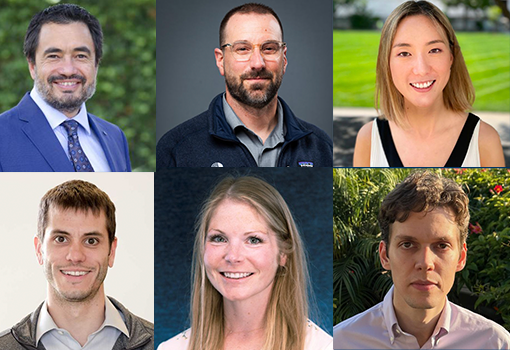
Caption: COAST PCL leadership (clockwise from top left) Javier Read de Alaniz, Tal Margalith, Haewon Jeong, Chris Dunham, Kaitlin Albanese, Christopher Bates

BioPACIFIC MIP lab assistant Marissa Beyer loads an automated robotic liquid handler inside the laboratory. The COAST PCL will be built around the BioPACIFIC MIP infrastructure at OASIS.