
A 430-watt solar-powered table built by the UC Santa Barbara chapter of Engineers Without Borders (EWB) was recently installed outside the Chemistry Building. The piece of outdoor furniture features integrated solar panels that generate electricity to charge various kinds of electronic devices, such as cell phones or laptop computers.
The UCSB chapter of EWB USA supports teams working in Rwanda, Panama, and Santa Barbara, all united by the mission to apply engineering skills in developing, sustainability-focused, community-centered solutions. The project was initiated in October 2023 when an official from the Isla Vista Recreation and Park District emailed the group with a problem: a solar-powered table installed at the People’s Park was no longer functioning.
“They had been having issues with the table, but they didn’t have the engineering expertise to fix it,” recalls Lily Chen, a fourth-year computer engineering student who served as the solar team lead at the time. “That’s when our team came in. With guidance from EWB mentor Marc Osborn, we restored the solar table to full operation. While working on this project, we also started wondering if we could design and build our own solar table.”
Commercial solar tables similar to the one built by the EWB team can cost from $10,000 to $12,000. Designing and building a table in-house would significantly reduce the cost while expanding access to renewable energy in campus. “It checked all the boxes,” Chen said. “Lower cost, sustainable power, something people could actually use — and hands-on engineering education for students.”
Working alongside project co-lead Arjun Gunda, a fourth-year mechanical engineering student, Chen recruited and mentored students — eventually forty students were involved — organized them into sub-teams and established a formal project structure. The students also secured funding from The Green Initiative Fund (TGIF) and UCSB’s Engineering Student Council, and received three Undergraduate Research and Creative Activities (URCA) grants totaling $4,500.
Serving as the lead project manager and designer, Gunda focused on optimizing the table’s structural system. Expanding on an archived senior capstone project, Gunda said, "Our reengineered design supported two panels instead of one — doubling the energy output. We also transitioned to an all-metal design instead of concrete, which improved durability and reduced cost.”
As the design was finalized, other teams advanced the electrical systems, campus approvals, and fabrication in parallel. Third-year computer engineering students Michael Krumland-Dunning and Riley Tang led selection and integration of the electrical components, while fourth-year mechanical engineering student David Bogdanovic coordinated campus approvals addressing safety, accessibility, and maintenance. With approvals secured, Alec Perkins oversaw fabrication and installation, working closely with UCSB’s machine shop staff to bring the design to life.
“Unlike classroom assignments with clearly defined steps, the solar table required adaptability, creativity, and collaboration as challenges arose,” said Ava Graef, a third-year mechanical engineering student, who contributed to structural design and helped with assembling the frame, wiring electrical components, and sewing the custom sun umbrella that completes the table.
The solar table project marked only the beginning for EWB’s solar team.
“The students have extended their work beyond campus, across the Santa Barbara community,” Chen notes. “Their new initiatives include high school outreach and engineering workshops, along with a portable field camera for use in environmental studies and for monitoring local wildlife reserves.”
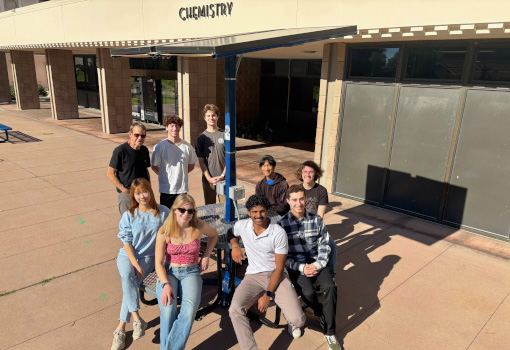
Front row (L to R): Lily Chen, Ava Graef, Arjun Gunda, David Bogdanovic
Second row (L to R): Marc Osborn, Camden Smith, Will Morgali, Riley Tang, Michael Krumland-Dunning.