
Various, and varied, large-scale networks of interconnected systems working in a synchronized way, from collections of neurons firing together, to fireflies flashing in unison, to the components of an AC power grid providing electricity to homes and businesses, share common, mathematically describable patterns, such that studying one type of network may offer valuable insights into others.
The underlying patterns and structures are especially important in large, complex systems such as those that control the electrical grid, monitor and maintain supply chains, and support transportation networks, where small disruptions can accumulate, leading to cascading effects and large-scale failures having serious consequences. Think of a delayed flight that also impacts your connecting flight — an inconvenience at the individual level but one indicative of the fragility of interconnected systems under exposure to unexpected disturbances.
Bassam Bamieh, a mechanical engineering professor at UC Santa Barbara and a member of the Center for Control, Dynamical Systems and Computation, has received a three-year, $470,000 National Science Foundation (NSF) grant to develop a mathematical model explaining why some complex networks remain resilient while others fail under small disturbances.
“What makes this project unique is the striking similarity between these vulnerabilities in large-scale networks and a well-known phenomenon in condensed-matter physics called Anderson Localization,” which shows that small amounts of disorder can dramatically change the behavior of electrons and light in a material. Understanding the role of Anderson Localization in the failure of large-scale systems is, he says, “at a nascent stage, but our preliminary evidence was strong enough to convince the review committee that this analogy could offer a new way of understanding network fragility.”
In the project, Bamieh will investigate how localization may reveal hidden weak points in large, complex networks. “What most people don’t realize is that the U.S. power grid is essentially a giant orchestra of machines,” he explains “You have thousands of generators — gas turbines, hydroelectric dams, and more — spread across the country, and yet, they rotate in synchrony. While separated by more than a thousand miles, a turbine in Washington state and the Hoover Dam in Nevada ‘sense’ each other’s motion and work synchronously, making it possible to transmit AC power efficiently. If the machines fall out of sync, voltage collapse and blackouts occur. It’s remarkable that this vast network of rotating machines is kept in step, tugging and balancing each other in real time to keep the lights on. Some describe the network of generators, transmission lines, distribution subnetworks, and all the appliances connected to it as the most complex machine ever built.”
Through this research, Bamieh hopes to uncover new principles for designing more robust and reliable networks, especially for the AC power grid. His team will include Poorva Shukla, a PhD candidate in the lab who has already published a paper on the problem of systemic fragility in AC power grids caused by network localization phenomena.
Bamieh, who has also developed a graduate course titled “The Control of Distributed and Networked Dynamical Systems,” and plans to combine the study material for it with other materials central to this proposal in an interdisciplinary textbook to be completed during the three-year project. Integrating concepts from dynamics and control, condensed-matter physics, and numerical linear algebra, the book is intended to bolster both education and cross-disciplinary research in diverse fields.
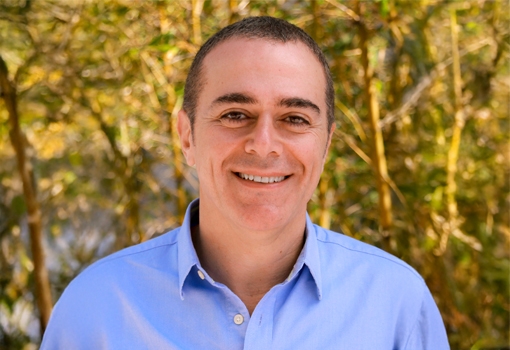
Bassam Bamieh, Mechanical Engineering Professor at UCSB