
A cyclist approaches from behind. Farther ahead, a construction barrier blocks the sidewalk. Along an unfamiliar route, an unexpected drop-off appears.
For a blind or low-vision traveler, recognizing those hazards quickly is critical. Many wearable vision systems, however, try to interpret the entire scene, consuming considerable computing power, memory and energy before determining whether something poses a threat.
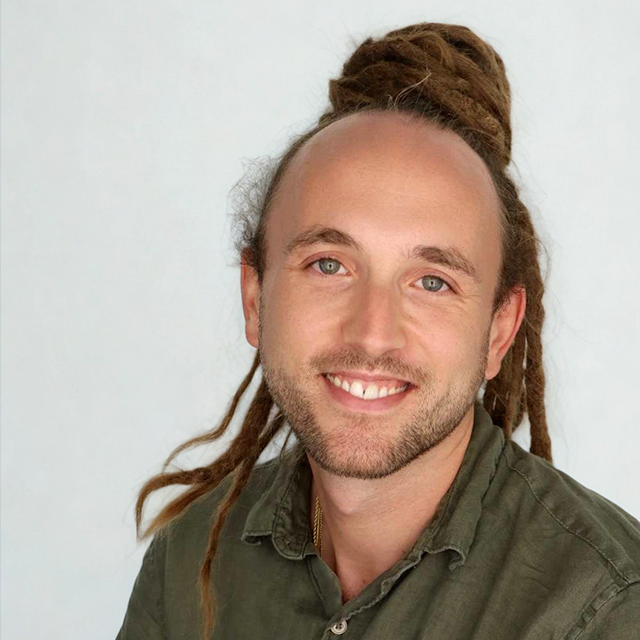
UC Santa Barbara postdoctoral scholar Marius Schneider is pursuing a more focused approach. Rather than identifying everything in view, his proposed system would concentrate on the most urgent information a traveler needs to determine if it is safe to keep moving.
Now Schneider has received the 2026–27 James V. & Beverly R. Zaleski Discovery Award in Robotics and Computing from The Robert Mehrabian College of Engineering. The award will provide up to $94,000 for his project, Residual Event Affordances: Neuromorphic Safety Computation for Mobile Edge Systems.
“It caught me by surprise, honestly,” said Schneider, who earned his PhD in neurophysics from Radboud University in The Netherlands. “You submit a proposal knowing that the pool is competitive and that a lot of it is out of your hands, and then you go back to your regular work. So, getting the news that it was funded was one of those moments where you have to sit with it for a while before it sinks in.”
The award comes as Schneider, who works in UCSB’s Bionic Vision Lab under Michael Beyeler, a computer science associate professor, begins defining a research direction of his own. His project combines neuroscience, event-based sensing, artificial intelligence (AI), and neuromorphic computing, a field that designs computer systems inspired by the structure and efficiency of the brain.
“This award provides the space and time to make the transition from postdoc to independent researcher in an environment at UCSB that has already shaped how I think about the science,” said Schneider.
Beyeler and Umesh Mishra, dean of The Robert Mehrabian College of Engineering, commended Schneider for his bold and novel research.
“Marius’s work captures what the college is all about, crossing disciplines, challenging conventional assumptions, and turning fundamental insight into technology with impact,” Mishra said. “His project is both highly inventive and grounded in a meaningful human need, which makes it an especially compelling example of engineering at its best.”
“Marius is exactly the kind of researcher this award is meant to catalyze, original, technically deep, generous as a mentor, and ready to define an independent direction,” added Beyeler.
Seeing Only What Changes
At the center of Schneider’s project is an event camera, which reports changes in brightness, registering motion pixel by pixel at the instant it occurs. In comparison, a conventional camera captures a succession of complete images, an energy- and data-intensive process that wastes precious time.
“For a wearable device that has to warn someone about a hazard, that difference matters enormously,” he said. “Speed matters — a fraction of a second is the difference between reacting and colliding.”
Because event cameras generate far less unnecessary data, they could enable faster warnings while extending battery life. They also introduce a new challenge: an actual threat could be obscured when the user’s own movements, such as walking or turning, create motion across the camera’s field of view.
Schneider’s system would learn to predict the visual changes caused by those routine movements and subtract them from the incoming data. What remains could reveal an approaching object or curb. The system would then estimate collision risk, the direction of danger, and alert a user to stop, slow down or move aside.
It would not necessarily need to know whether the threat was a bicycle, a trash can, or a jogger.
“Biological vision responds to immediate danger before fully interpreting everything in view,” Schneider said. “If a car swerves toward you while you’re crossing the street, you jump out of the way before you’ve consciously identified what kind of car it is.”
That principle runs counter to a prevailing trend in AI, where improved performance is often pursued through larger models, more training data, and greater computing power. Those advantages can become liability in a wearable device that must respond immediately, operate locally, and run for long periods of time on a small battery.
“The visual system in the brain isn’t one giant model computing everything,” he said. “It’s a series of specialized circuits, some very fast and some slower, arranged so that urgent signals get priority.”
From Mouse-vs-AI to Wearable Safety
Schneider began developing that idea through Mouse-vs-AI, a research platform he and colleagues introduced at the annual conference on Neural Information Processing Systems (NeurIPS), which places mice and AI agents in comparable virtual foraging tasks. Both must navigate an environment and find rewards while researchers vary visual conditions, such as lighting, fog, and clutter. The idea of the platform originated in the lab of UCSB electrical and computer engineering professor Spencer L. Smith, who provided the mouse foraging data.
The experiments allowed Schneider to compare how biological and artificial vision systems respond when familiar conditions suddenly change. AI agents generally needed repeated exposure and additional training. Mice often adapted immediately.
“The mice hadn’t seen any of it in the lab, and they just handled it,” Schneider said. “Something about how their visual system is structured lets them generalize on the first encounter, without needing to have seen every situation in advance.”
The mice also did so with remarkable energy efficiency. While AI systems have to drain their computing budgets, Schneider said,” a mouse navigates a complex environment on the energy of a few calories.”
To achieve both adaptability and efficiency, the brain “doesn’t reconstruct the whole scene from scratch on every frame. It predicts, it uses movement signals, and it only pays attention to what wasn’t predicted,” he explained. “That’s the intuition behind the current project.”
“What makes Marius distinctive is that he can connect levels that are often kept separate: dynamical systems, cross-area neural computation, active behavior and modern AI architectures,” Beyeler said. “Many people can model neural activity. Far fewer can turn principles of neural dynamics into closed-loop computational frameworks that generate new scientific and engineering questions.”
Building a Foundation
Schneider will begin the new project in a virtual urban environment. A simulated blind or low-vision pedestrian equipped with an event camera will encounter curbs, moving people, obstacles, changing weather, and varied body movements.
The controlled setting will allow Schneider to know precisely when a collision is likely, how quickly a hazard is approaching and which action would prevent it. He will compare his model against conventional camera-based AI and existing event-camera systems before determining whether it can run within the constraints of specialized neuromorphic hardware, which are brain-inspired computer chips that physically mimic biological neurons and synapses to process data.
Accuracy will be only one measure of success. Schneider will also evaluate warning time, missed hazards, false alarms, memory use, computing demands, and energy consumption. He plans to release both the model and its benchmark environment as open-source resources, allowing other researchers to test and build upon the work.
The practical need is clear. A cane can detect an obstacle only when it reaches it. It cannot provide advance warning of a passing e-bike, a barricade on the sidewalk, or sudden changes from pavement to gravel.
“That’s a real gap, and it’s the kind of gap where the perception research I’ve been doing could actually help,” Schneider said. “It’s not a vague ‘AI for good’ wish. It’s a concrete perceptual problem where the computation I’ve been thinking about in a basic-science context is genuinely a candidate for the solution.”
An effective device, he said, would demand little attention from the person wearing it. It would remain quiet most of the time and intervene only when action was needed.
Within five years, Schneider hopes to move the work from simulation and benchmarking to a wearable prototype that blind and low-vision users can test in real-world settings.
“The deeper hope is that this kind of technology could shift what an ordinary day looks like for someone with a visual impairment,” Schneider said, “that it becomes possible to explore a new city, or take an unplanned detour, or move through a crowd, with the same degree of casual confidence that sighted people take for granted.”
A rendering of The event camera that will be used in the project depicted next to the physical hardware that will be used in the device.

A conceptual rendering of the wearable technology, including the event camera (pictured on the left) and the physical hardware.