
UC Santa Barbara undergraduate Katherine Santiago led a three-person team that finished in second place and earned a cash prize of two thousand dollars as part of the Math, Engineering, Science Achievement (MESA) Idea Accelerator Program. The team presented its project — a website to help students find safe, affordable housing — in November at the MESA Student Leadership Conference in San Francisco, which attracted undergraduates from forty-six colleges and universities across California.
The MESA program serves more than twenty thousand students in California, from kindergarten through college, who are taking STEM courses and pursuing STEM careers, with a focus on students from economically or geographically challenged schools. The annual leadership conference provides undergraduates with an opportunity to meet industry professionals, attend leadership and communications workshops, present pitches as part of the Idea Accelerator Program, and participate in an additional team design challenge on site.
The leadership conference is one aspect of MESA’s wide-ranging support system for undergraduates, which includes on-campus support, tutoring, career workshops, and community-building activities. “The program’s mission is to retain students in their STEM studies and set them up for success in their future careers,” said Melani Castellanos, the MESA University Program interim director and the K-20 program coordinator under the UCSB Office of Education Partnerships.
“The MESA Student Leadership Conference and the MESA University Program here at UCSB give our engineering and STEM students the connections and support that help them thrive,” said MESA co-principal investigator Glenn Beltz, who is also a mechanical engineering professor and associate dean of Undergraduate Studies in The Robert Mehrabian College of Engineering. “Working with UCSB’s Office of Education Partnerships, and strengthened by dedicated alumni and industry partners, we support students from K–12 through university. We’re proud of all who attended the conference, and are especially delighted to see Katherine Santiago recognized for her outstanding work in the MESA Idea Accelerator program.”
Charting a Path to Better Housing
Santiago, who is studying mechanical engineering, began the process that led to the competition by participating in a two-day entrepreneurship boot camp held in Oakland in August. She and her teammates, who are students at Cal State Sacramento and Fullerton College, then met weekly online over the next two months to develop Campus Crib, a prototype housing platform that matches students with safe, affordable housing.
Santiago said that the project was inspired in part by the housing challenges she and other students have experienced. “As we were developing our idea,” she recalled, “I was searching for housing, and I was also hearing from friends who had moved to Santa Barbara and were either having trouble finding housing or had been paired with difficult roommates.”
The problem is not unique to UCSB. “Twenty thousand people in the UC system identify as having housing insecurity,” Santiago said, “which can mean that they don’t have somewhere they feel safe to go at the end of the day, or that they don’t have enough money to make the next month’s rent.”
Without safe housing, financial assistance, and support, students — many of whom have already overcome significant obstacles to get to university — may struggle to stay in school, an issue that is central to MESA’s mission to retain students in school and support their success, said Castellanos.
At UCSB, MESA supports up to three hundred students every year. MESA welcomes incoming STEM students throughout their undergraduate years at UCSB by offering the MESA Successful Transition Program (M-STP). This past summer, M-STP provided a three-week virtual program for incoming UCSB freshman and transfer students, which included coursework in data science, math, and chemistry, along with networking.
MESA Gives Long-term Support to Students and Alumni
Santiago first learned about the UCSB chapter of MESA in spring 2025 through an announcement about the accelerator program. After starting the Idea Accelerator Program in August, Santiago found that she had a new MESA community on campus once she returned to UCSB after the summer. And MESA’s partnership with Los Ingenieros, an engineering community primarily serving Latin@ students, means that “it ties in with a lot of segments of my identity,” she said.
With the award, Santiago plans to continue to conduct research to develop the student housing site and to apply for further funding from two UCSB sources, the UCSB Office of Undergraduate Research & Creative Activities and the New Venture Program. In addition, she will continue to be involved in MESA’s on-campus programs and extensive alumni network. “MESA gives you really good exposure and connections to people who are already in the field,” Santiago said.
Many alumni — including MESA interim director Castellanos, a former MESA student at UCSB — credit MESA with their success in STEM. At UCSB, the program brings back alumni to an annual awards banquet, where they can connect with current students and continue that tradition of support.
“We really like to see the students go through the pipeline, finishing college and going into industry or graduate school,” Castellanos said. “And we really want to connect students who are thinking of grad school or internships with our industry partners and other opportunities that they may be interested in participating in.”
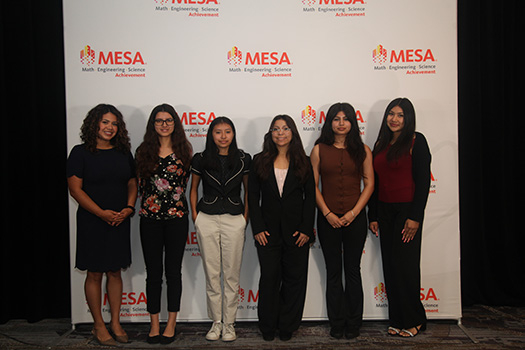
UCSB undergraduates at the MESA Student Leadership Conference, where Katherine Santiago (third from left) received an award from the MESA Idea Accelerator Program