
Four PhD students affiliated with The Robert Mehrabian College of Engineering at UC Santa Barbara — Thomas Tang, Amir M’Saad, Erick Lawrence, and Akhila Mattapalli — have been awarded 2025 National Defense Science and Engineering Graduate (NDSEG) Fellowships, one of the most competitive honors for graduate students in science and engineering. Funded by the U.S. Department of Defense (DoD), the NDSEG Fellowship provides three years of full tuition, a $44,400 annual stipend, health insurance, and travel funds. This year, 126 fellows were selected from nearly sixty universities nationwide, underscoring the competitiveness of the program.
"Earning an NDSEG Fellowship is a mark of exceptional promise and achievement," said Janine Jones, associate vice chancellor for graduate affairs. "We commend these students for their commitment to advancing knowledge and addressing critical challenges through research. With the support of this fellowship, they are well-positioned to become leaders in their fields and to contribute meaningfully to scientific and technological progress.”
“We are incredibly proud of Thomas, Amir, Erick, and Akhila for earning this highly competitive and prestigious fellowship,” said Umesh Mishra, dean of The Robert Mehrabian College of Engineering. “Their achievements reflect the strength of our graduate programs and the exceptional caliber of students who choose UCSB to pursue impactful research. The NDSEG Fellowship not only recognizes their talent and dedication, but also reinforces our commitment to advancing science and engineering in service to society.”
“Receiving the NDSEG Fellowship is an incredible honor,” said Akhila Mattapalli, a second-year materials PhD student. “I am deeply grateful for the support my advisor and the materials community at UCSB have given me in the last year, and I plan to use this opportunity to the fullest as I work on projects at the forefront of the semiconductor research community.”"
Advised by materials associate professor Sriram Krishnamoorthy, Mattapalli studies beta-gallium oxide (β-Ga₂O₃), an emerging wide bandgap semiconductor that enables operation at higher power levels and frequencies than existing materials allow. Her research focuses on designing and fabricating vertical transistors using β-Ga₂O₃ films grown by metal-organic chemical vapor deposition (MOCVD).
“Further understanding of β-Ga₂O₃ epitaxial growth and the electronic properties necessary for creating a high-performance transistor will improve our understanding of the entire developmental process,” Mattapalli explained.
She added that the technology has the potential to reduce the environmental impact of global power consumption.
“As data centers and electronic systems continue to demand great power-handling capability, my project aims to address that need by developing a device that combines high performance, efficiency, and reliability in extreme operating conditions,” she said.
Previously from the University of Utah, where he earned both a bachelor’s and master’s degree in materials science and engineering, third-year materials PhD student Erick Lawrence is advised at UCSB by materials associate professor Raphaële Clément.
“At a time when funding insecurity is at an all-time high, having three years of guaranteed support to complete my PhD is a particularly powerful resource that I’m very grateful for,” said Lawrence. “This fellowship will allow me to pursue the research that I find most interesting and impactful.”
Lawrence’s research focuses on developing next-generation lithium-ion batteries that avoid the use of scarce and ethically problematic materials such as cobalt and nickel. Under Clément’s guidance, he is investigating manganese-based disordered rocksalt (DRX) cathodes, a promising class of materials that could deliver high energy density while relying on more abundant and sustainable elements.
His proposed work explores incorporating these DRX cathodes into all-solid-state lithium-ion batteries, which replace conventional flammable liquid electrolytes with solid-state lithium-ion conductors.
“Currently, little research has been performed to understand how DRX materials can be integrated into all-solid-state batteries,” Lawrence explained. “Our goal is to test the chemical stability of DRX with different solid-state electrolytes, identify the optimal combinations, and evaluate battery lifespan and degradation mechanisms.”
Lawrence’s project could have far-reaching implications for both the Department of Defense and the general public. By advancing manganese-based cathode technologies, his work supports the development of domestic, cobalt- and nickel-free battery supply chains that reduce costs, enhance safety, and improve global resource sustainability.
“Reducing reliance on critical minerals from volatile regions strengthens American resilience to global instabilities,” Lawrence said, “and could help make electric vehicles more affordable and competitive with traditional combustion technologies.”
A second-year materials PhD student at UC Santa Barbara, Amir M’Saad is advised by materials professor James Speck. His research focuses on developing advanced processing techniques for gallium nitride (GaN) power electronic devices, materials that can operate under extreme electric fields and convert power with greater efficiency than conventional silicon-based technologies.
M’Saad’s proposed NDSEG project, “Gallium Nitride Vertical Superjunction Structure for Extreme Electric Field Electronics,” aims to address one of the key challenges in power electronics: the tradeoff between handling high voltages and minimizing resistance.
“The superjunction concept mitigates this tradeoff to achieve both high voltage capability and low loss,” he explained. “While this has already been demonstrated in silicon, realizing it in GaN requires entirely new growth and processing approaches to achieve the same level of performance.”
By optimizing the growth of GaN crystals with low defect density and refining device fabrication techniques, M’Saad’s work could pave the way for more efficient and compact power converters. The implications of his research are broad, potentially resulting in lighter, cooler, and more reliable systems for aircraft, ships, directed-energy platforms, and satellites.
“For the general public, these same advances can improve the performance of electric vehicles, renewable energy systems, and data centers — reducing energy losses, cutting costs, and lowering carbon emissions,” said M’Saad, who completed a bachelor’s degree in nanoengineering at UC San Diego.
Reflecting on the fellowship, M’Saad expressed deep gratitude to his peers and research group for their mentorship and feedback during the application process.
“It’s quite an honor,” he said. “I wasn’t expecting to receive it, but the support of my peers and group members helped shape the technical direction and clarity of my proposal. This award is really a reflection of the collaborative environment at UCSB.”
A third-year chemistry and biochemistry PhD candidate at UC Santa Barbara, Thomas Tang is advised by Arnab Mukherjee, an associate professor of chemical engineering. Tang’s research sits at the intersection of bioengineering and molecular imaging, where he is developing innovative tools to detect and monitor protein misfolding, a hallmark of neurodegenerative diseases such as Alzheimer’s and Parkinson’s.
“The NDSEG Fellowship is an incredible privilege,” said Tang, who earned his bachelor’s degree in biology from Cal Poly, San Luis Obispo . “It’s an honor to know that my proposed research is worthy of support, especially at a time when research funding faces growing uncertainty. Professionally, it opens a lane to pursue work for the government after my PhD, and I’m excited about the mentorship and networking opportunities that come with it.”
Tang’s proposed project focuses on creating genetic circuits and sensors that connect pathological molecular events to magnetic resonance imaging (MRI) signals. While current diagnostic techniques rely heavily on positron emission tomography (PET), which offers limited resolution and exposes patients to ionizing radiation, MRI provides a safer and more detailed imaging alternative. However, one of the drawbacks of using MRI for disease detection is the lack of molecular-level tools available. By engineering biological systems that generate MRI contrast in the presence of protein aggregation, Tang aims to enable sensitive, noninvasive imaging of protein misfolding in animal models. His work has the potential to transform how neurodegenerative diseases and brain injuries are detected and studied.
“My research could allow us to diagnose proteinopathies like Alzheimer’s and Parkinson’s earlier for soldiers, veterans, and civilians alike,” Tang explained. “It’s especially relevant for the Department of Defense, since many service members suffer traumatic brain injuries that can lead to harmful protein aggregation. By capturing these molecular changes in real time, we can devise preventative treatment strategies to mitigate long-term effects.”
Ultimately, Tang envisions his research translating into a clinical diagnostic platform that improves early detection, guides therapeutic development, and deepens understanding of the biological mechanisms driving protein aggregation.
Established in 1989, the NDSEG Fellow Program support the training of U.S. scientists and engineers in disciplines of strategic importance to the DoD. Since its inception, more than 4,700 fellowships have been awarded and more than 70,000 applications have been received, an acceptance rate of seven percent.
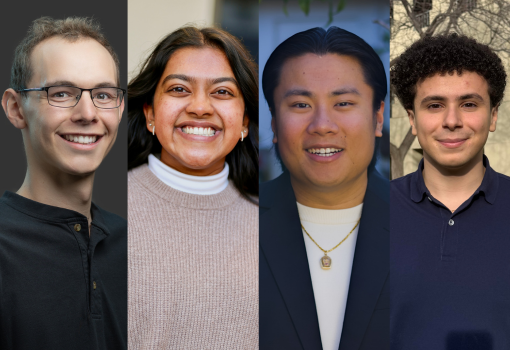
(From left to right) Erick Lawrence, Akhila Mattapalli, Thomas Tang, and Amir M'Saad were awarded 2025 National Defense Science and Engineering Fellowships.