
Prithvi Dake and Jaewon Lee, third-year PhD students from UC Santa Barbara’s Chemical Engineering Department, have been awarded prestigious Mitsubishi Chemical Fellowships. The two-year fellowships were granted by the Mitsubishi Chemical Center for Advanced Materials (MC-CAM), an interdisciplinary materials center that enables a research partnership between the Mitsubishi Chemical Corporation (MCC) and the larger materials-science community at UCSB.
“Knowing how many of my colleagues are doing outstanding research, this fellowship is a strong motivator to keep pushing forward,” said Lee, a PhD candidate in the lab of assistant professor Tyler Mefford.
Lee’s research is focused on developing electrocatalysts — materials that can be used to store renewable energy efficiently and sustainably, using rechargeable liquid fuel which is easier to transport and store at a large scale. He explained, “Energy storage in liquid form is preferred because it makes the transportation and storage costs cheaper for a given energy density. Liquids, unlike gases or solids, are easy to transport, pump, and store using existing fuel infrastructure — tanks, pipelines, and refilling systems — which means we can leverage decades of engineering development.”
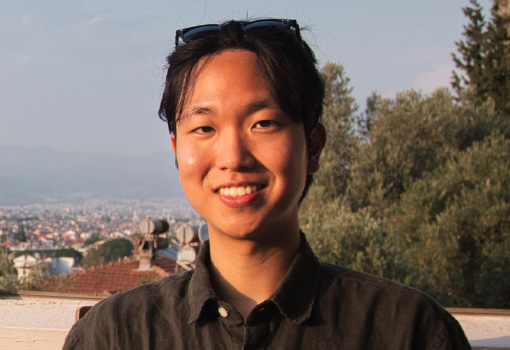
Jaewon Lee, 3rd-year PhD student in UCSB's Chemical Engineering Department
Lee’s work addresses one of the biggest challenges with renewable energy — its intermittency, which relates to the unpredictable energy production from sources like sun and wind, due to changing weather conditions. “By turning renewable electricity into liquid fuel,” he said, “we can capture excess energy when it’s available and release it when it’s not, supporting a cleaner and more reliable energy grid, and reduce reliance on fossil fuels.
Recognizing what he described as Lee’s ability “to combine bold vision with technical depth,” Mefford described why Lee was a perfect recipient of the fellowship. “The Mitsubishi Chemical Fellowship recognizes the high-risk, high-reward nature of his vision, which is to transform clean energy from an aspiration into a reliable, scalable, and affordable reality.”
Lee’s emphasis on innovation and scientific rigor reflects the broader mission of the MCC projects, which are selected for their novelty, relevance to MCC’s business goals, and scientific merit. Dake’s research, which lies at the intersection of artificial intelligence and chemical engineering, is right in line with those requirements.
Advised by chemical engineering professor James Rawlings, Dake is challenging the notion that data-driven models can be applied universally without scrutiny. “Machine-learning models, especially neural networks inspired by the brain, are often promoted as one-size-fits-all tools for modeling, optimization, and control in chemical engineering,” he explained. “But we rarely ask whether their predictions can be trusted, or whether they are safe to use in high-stakes settings, such as refinery hydrocrackers, or pharmaceutical crystallization, where mistakes can be costly and dangerous.”
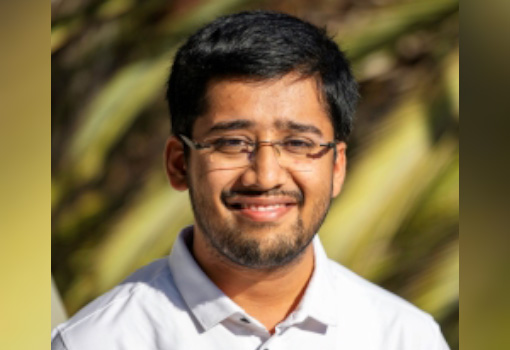
Prithvi Dake, 3rd-year PhD student in UCSB's Chemical Engineering Department
Dake’s goal is to build hybrid models that combine the rigor of first-principles equations like the conservation laws and thermodynamic/kinetic relations, with the adaptability of AI. He said, “By enforcing physics and constraints, and letting AI learn only what the equations don’t capture, we can design decision systems that are robust, reliable, and safe.”
In his project, titled “Not Every Data-Driven Model Plays Nice,” Dake aims to design a single dependable AI framework that can be applied to many problems, overcoming the limitation of having to craft separate, and quite fragile, solutions for each case.
“His research will help us better understand when data by itself is insufficient to build models suitable for deciding how to operate industrial processes safely and profitably,” Rawlings said.
Both Lee and Dake said they have found collaboration to be integral in shaping their research projects. For Lee, having the freedom to choose equipment during the lab’s setup process was invaluable in supporting his research, and for Dake, UCSB’s collegial culture and frequent discussions with peers helped refine his ideas about trustworthy AI models for chemical systems. Both students, and their projects, provide examples of how UCSB’s interdisciplinary community supports turning shared curiosity into innovation.
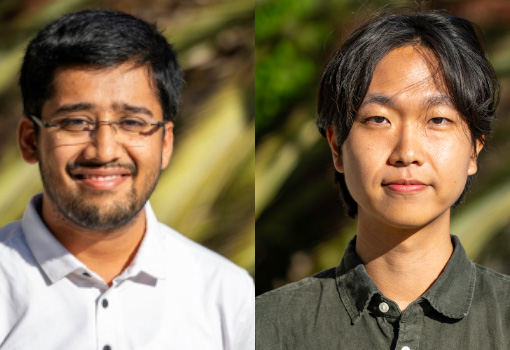
Prithvi Dake (left) and Jaewon Lee (right), recipients of the Mitsubishi Chemical Fellowship.