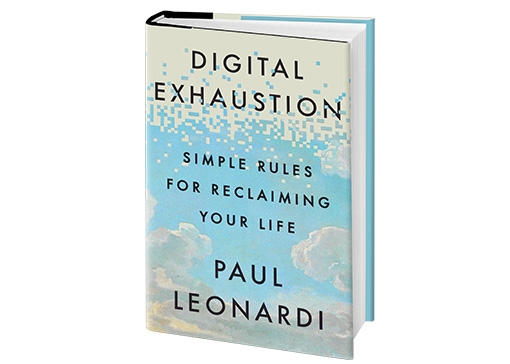
Have you ever come back from a blissful, disconnected vacation — swearing that you would bring this new, low-tech approach back to your daily life — and a few days later, felt as if the stream of texts, emails, alerts, and beeps have more of a hold on you than ever? Paul Leonardi, department chair and Duca Family Professor of Technology Management at UC Santa Barbara, thinks that there’s a better way. In his new book, Digital Exhaustion: Simple Rules for Reclaiming Your Life, he brings twenty years of research to examine why our digital life is so overwhelming, and what we can do to feel like our tools are working for us.
“My whole research agenda has been about how we take advantage of new tools to organize in new ways, to create new kinds of efficiency, and to improve our ability to share knowledge effectively in organizations,” says Leonardi. “But there's always this dark side. At the same time that these tools do great things for us, if we don't approach them in the right ways, they can lead to a sense of fatigue and burnout.”
In working with companies to design effective organizational networks to make the best use of new technologies, Leonardi has often surveyed employees about digital burnout. But during the COVID-19 pandemic, he started to hear such stories unprompted. In-office meetings and weekend meals with family and friends turned into an essential, yet endless, series of Zoom meetings, family FaceTimes, and group chats. “It was an overwhelming time, because we were so dependent on our tools,” Leonardi says.
In 2022, Leonardi and his co-author, Harvard Business School professor Tsedal Neeley, published their book Digital Mindset: What It Really Takes to Thrive in the Age of Data, Algorithms, and AI. While on tour for the book, he noticed that employers, while excited about boosting digital fluency in the workplace, were also concerned about their employees’ potential digital burnout by adding new tools like generative AI on top of the current slate of existing technology. Feedback from employees at all levels of the workplace prompted the new book, in which Leonardi explores the research documenting the causes of digital exhaustion and provides an extensive set of tips for digital newcomers and digital natives alike to reclaim ownership of their tools — and, hopefully, their lives.
The Importance of Being Intentional
Most people sit down at the computer to work with the best of intentions, Leonardi says. “Then you open up a window, click on an app, go to a website — and you find yourself spiraling out into all of these different spaces. All the clicking, the exposure to new information, the reading, the processing, the bookmarking, and all the rest can be exhausting. And then you wonder where the last forty-five minutes went.” It happens at home, too. Picking up the phone to check a message can turn into a deep dive into your distraction of choice.” (For Leonardi, it’s Zillow.)
In his book, Leonardi describes multiple studies that point to the importance of using apps and devices intentionally, as well as successful steps many of his interviewees have taken that work for them — approaches that include having a designated time to respond to texts, making apps less easy to access, and disabling shortcuts on devices. “For me,” Leonardi says, “that has meant that every time I open up an app, every time I click on a new website, every time I pick up my phone, I'm always taking a breath and asking myself, OK,, what am I trying to accomplish?”
Pick Some Apps — and Ditch the Rest
Leonardi has worked with clients on reducing the number of platforms they use, since using too many can create subtle energy sinks that add up. “For me, one of the biggest stresses and drains is in video-conferencing apps,” he says. “Switching from a Zoom meeting to Microsoft Teams, then hopping over to Google Meetup means reorienting yourself to the small differences — how to share your screen, even mute yourself — each time. “That might not sound like much,” he says, but each of those shifts, interactions, and re-orientations is mentally exhausting.”
Leonardi says that to streamline when planning a meeting, he sometimes assumes the role of scheduler so that he can be the one sending out a Zoom link — his preferred platform — or make a request to use that method when others are doing the organizing.
Wait It Out
When it comes to work-related messaging, it may feel that the best response is the fastest one. But Leonardi and others have found that what’s called the “email urgency bias” may be adding to digital exhaustion. In fact, he says, citing multiple studies, “Most of the time, we perceive other people's queries to be much more urgent than they do.”
One approach Leonardi suggests in the book for reducing email exhaustion is to wait a bit to send a response and then to write a longer, more complete message. “When we send more comprehensive, longer messages, people tend to respond to us less frequently,” Leonardi says. “And if you track the metabolic energy that we're spending, it costs much less energy to write one nice, long email than it does to respond to six short ones, especially when they're coming at times that aren't really convenient for us.”
In the end, Leonardi says, approaches to reducing digital exhaustion will be different for different people. (A chart in the book’s appendix can help readers tailor Leonardi’s strategies to their individual situations.) “Everybody has the power to reduce their digital exhaustion,” Leonardi says. “But we all experience digital exhaustion differently, so we each need different solutions.”