
Two UC Santa Barbara chemical engineering PhD students, Ryan Berry and Norleakvisoth Lim, were recognized with top honors for their research presentations at the International Forum on Energy & Informatics, an international conference that brings together researchers working at the intersection of energy science, information technology, artificial intelligence, data science, and materials.
Berry, a fourth-year doctoral student, received the forum’s highest student distinction, a Gold Medal for best presentation, while Lim was awarded a Silver Medal for his research presentation. Held this year in Thailand by the Institute of Science Tokyo, the specialized academic gathering connects students, faculty, and industry partners from leading institutions around the world to advance sustainable, technology-driven energy solutions.
“Receiving this award is a humbling experience,” said Berry, a recipient of the Chemical Engineering Department’s Dow Discovery Fellowship in recognition of his innovative research. “The award reflects the incredible support I’ve received from my mentors and colleagues, and it motivates me to keep learning and pushing forward.”
Co-advised by chemical engineering professors Phillip Christopher and Michael Gordon, Berry studies photocatalysis, a process in which light drives chemical reactions on supported metal nanoparticle catalysts used for chemicals manufacturing and sustainable technologies. Berry uses pulsed visible light to study and manipulate reactions occurring on catalyst surfaces with the goal of gaining mechanistic insight as well as improving the performance of traditional catalysts.
Berry was recognized for his presentation, “Using Pulsed Visible Light to Control and Interrogate Surface Adsorbates,” which described his work developing a high time-resolution infrared spectrometer to study dynamic and resonant photocatalysis.
“The guiding theory behind resonant photocatalysis is that if we can continuously perturb quasi-equilibrated steps in a reaction mechanism at, or faster than, the timescale of key steps, higher reaction rates could be achieved,” Berry explained. “The challenge has been both rapidly controlling the reaction environment and measuring what actually happens on the catalyst surface as those changes occur.”
Using the newly developed spectrometer, Berry and his collaborators can measure surface-bound molecules under dynamic photocatalytic conditions with millisecond time resolution, with the goal of eventually reaching microsecond timescales. Achieving that level of precision would allow researchers to uncover changes in reaction mechanism under dynamic conditions.
A National Science Foundation Graduate Research Fellow, Lim focuses his research on plasma-driven hydrocarbon conversion, the process of transforming fossil fuels such as methane, the main component of natural gas, into cleaner fuels like hydrogen or into more valuable chemical products. Rather than relying on energy-intensive heat alone, his work uses plasma, ionized gas, to drive chemical reactions more efficiently. His research spans systems ranging from high-pressure gases to liquid reactants, with an emphasis on understanding how rapidly changing, non-equilibrium plasma conditions influence chemical reaction pathways.
He earned his Silver Medal for his presentation, “Influence of Nanosecond to Millisecond Pulsed Plasmas on Methane Conversion and Product Selectivity.” In this work, Lim investigated how the timescale of electrical pulses can be used to steer chemical reactions, converting methane into more useful products while minimizing waste. This approach offers a promising alternative to conventional methods that require high temperature and often impose significant materials and engineering challenges.
“Receiving the medal was both an honor and a strong validation of my research,” Lim said. “Personally, it acknowledges the time and effort I’ve dedicated to my work. Professionally, it highlights the potential impact of my research and encourages me to keep pushing forward in sustainable energy work.”
His findings show how dynamically controlling plasma excitation can direct reactions toward selective hydrogen and hydrocarbon production, an advance that could help reduce wasted natural gas, improving energy efficiency, and support cleaner, more flexible energy and chemical manufacturing systems.
Looking ahead, Lim plans to extend this work to liquid hydrocarbons, where plasma behavior is influenced by complex multi-phase interactions and coupled charge and heat transport, an area that could further expand the practical applications of plasma-assisted energy conversion.
Together, Berry’s and Lim’s recognitions highlight UCSB’s leadership in chemical engineering research spanning catalysis, materials, and energy systems, as well as the global impact of its graduate students on emerging energy challenges.
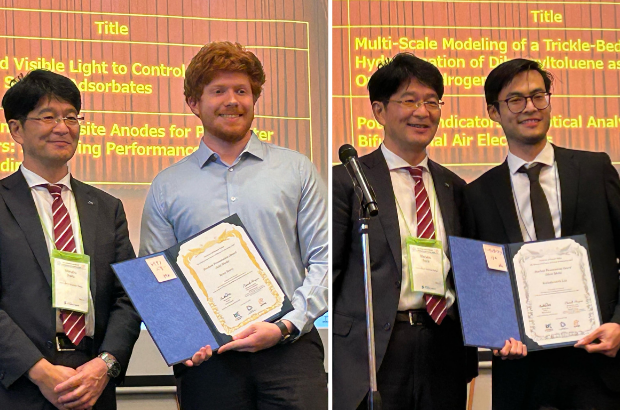
Ryan Berry (left) and Norleakvisoth Lim are presented with their awards by Manabu Ihara, director of the Institute of Science Tokyo's Academy of Energy and Informatics.