
Last August, five years after receiving an initial $23.8 million grant from the National Science Foundation (NSF), the Biomaterials, Polymers and Advanced Constructs from Integrated Chemistry Materials Innovation Platform (BioPACIFIC MIP) at UC Santa Barbara received an NSF renewal grant of $19.8 million.
The new funding extends the ability of researchers affiliated with the platform, a collaboration between UCSB and UC Los Angeles, to continue uniting synthetic biology, chemistry, automation, and artificial intelligence to advance the frontier of how bio-based materials are discovered, designed, and deployed.
The big news for 2026 is that BioPolymers, Automated Cellular Infrastructure, Flow, and Integrated Chemistry Materials Innovation Platform (BioPACIFIC MIP) has a new off-campus home at OASIS, an off-campus building in the nearby Goleta tech district, and formerly the home of the UCSB startup Apeel Sciences. With its equipment installed in the expansive OASIS laboratory spaces, the “new” MIP is ready to roll.
“Moving the BioPACIFIC MIP to OASIS represents the first critical affirmation of the value OASIS brings to UCSB: taking research from campus, where the focus is primarily research, to OASIS, where the emphasis is primarily to amplify the impact of the technology that comes out of the BioPACIFIC MIP,” says Umesh Mishra, dean of the Robert Mehrabian College of Engineering at UCSB. “What makes BioPACIFIC MIP such an important first mover is the world-leading research conducted there, as well as both the motivation of center participants to engage beyond campus and the stage of the research outcomes, which make it possible to do so.”
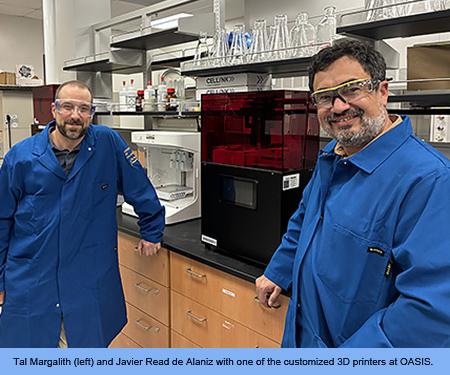 On a recent visit to the facility, Javier Read de Alaniz, UCSB professor of chemistry and biochemistry, and BioPACIFIC MIP director, joined Tal Margalith, executive director of strategic initiatives and innovation at the Robert Mehrabian College of Engineering, to discuss the benefits of the new location and the vision for a revolutionary approach to polymer discovery that will be undertaken there.
Automated Science
The key components of the MIP are two high-throughput, automated state-of-the-art systems for the discovery, synthesis, and characterization of new polymers. The vision, Read de Alaniz says, is that the lab housing the system eventually will be augmented with equipment to make it cloud accessible, and fully automated.
Realizing the latter vision will require additional funding, which has been applied for. Should it be secured, “You’ll have robots connecting the equipment,” Read de Alaniz explains, indicating a track running diagonally across the lab, which is already prepared to receive the robotic arm that will make remote chemistry real. “People, whether here in Santa Barbara, or elsewhere in the United States, could control the instrumentation and the process flow from a computer. Such a system would allow for remotely controlled synthesis of materials at one station, which would then move to a connected station for characterization. The robot would then remove the samples from the characterization tray, making many of the workflows completely autonomous.”
The abundant lab space in the new OASIS building is what makes such an ambitious plan realistic. “That is one of the strategic reasons why we moved here,” Margalith says. “We now have the space and the infrastructure to move in a completely new and exciting direction.”
That includes using a continuous-flow system (installed initially in Elings Hall) to synthesize new materials in a fundamentally different way. “Instead of performing chemistry in a round-bottom flask”, notes Read de Alaniz, “the reactions take place inside small tubing, typically a few millimeters to about a quarter-inch wide, arranged in compact loops”. Although the tubing may appear modest in size, the internal volume is comparable to that of a traditional reaction vessel. Scaling material production simply requires more tubing or operating the system for a longer period of time.
“You're using pumps to deliver reagents, which are mixed under controlled conditions within the tubing, and the product is continuously collected at the outlet,” he continues. “In contrast to conventional batch synthesis, this approach enables scale-up from quantities of, say, one hundred milligrams to a kilogram, without changing the size or the footprint of the reactor. Since the system can be directed remotely, it is easy to control how much material is produced: run the reaction for an hour to yield a small amount, or run it for twenty-four hours for a much larger yield. Basically, you can make material continuously.”
3D Printing: From Material to Device
Several state-of-the-art, commercially available 3D printers occupy part of another lab bench near the continuous-flow system, which MIP researchers have modified, Read de Alaniz says, “so that we can leverage these new materials for potential use in artificial muscles, adaptive soft robotic systems, and next-generation biointegrated devices.
“All of these printers make use of light to polymerize materials. Typically, they're sold to operate with only one wavelength of light, but we have modified them to have five separate wavelengths, so that they can trigger polymerization of various monomers under a range of conditions. You could, for example, use different wavelengths of light to make a material that is rigid in one area and soft in another. Currently, materials are either rigid or flexible, but not both.”
“Some medical devices, such as splints and prosthetics, have both rigid and soft sections, but those are large-scale objects,” Read de Alaniz explains. “We’re working on very small materials that don't require a full mechanical assembly.”
Big Space for Startups
A lab adjacent to the materials lab will become a dedicated start-up space having much more area than what was available in the very successful startup lab on campus at CNSI.
The ability to bring so much MIP infrastructure to OASIS was made possible by the initial NSF investment, since $20 million of that grant went to build the infrastructure,” Margalith notes. “The advantage that OASIS offers is space for deeper industrial collaboration in a centralized facility. That industry support is what will enable the facility to be, essentially, self-sustaining.”
CNSI Support
While BioPACIFIC MIP has moved from its former Elings Hall CNSI home, it has in no way separated from it. “One especially important piece of the OASIS relocation is the ongoing support provided by CNSI, both administratively and programmatically,” Margalith observes. “The people who operate CNSI have tremendous expertise in managing large interdisciplinary centers, which is critical for an endeavor of this scale. Moreover, CNSI's leadership in innovation programming and workforce development targeting ’hard technologies’ allows BioPACIFIC MIP to tap into resources such as those supporting our undergraduate trainees or training our researchers to identify innovations that have commercial potential.”
Some of the BioPACIFIC’s MIP footprint remains on campus, which, Margalith says, “optimizes certain characterization workflows and allows our researchers to continue leveraging the world-class shared facilities at CNSI and the Materials Research Laboratory. CNSI has also been very supportive in maintaining a shared BioPACIFIC MIP office suite in Elings Hall so that the students have an easy place to land when they are on campus.”
Collaboration underscores the success of the UCSB research enterprise, and OASIS extends the value of that approach. “Having the space to do big things will catalyze many new collaborations with faculty on campus who haven't engaged with us before,” Margalith says, adding, “We’re really excited to engage with researchers working in robotics, data, and AI to advance the evolution of the MIP infrastructure.

A PhD student works on the continuous-flow system at OASIS, where flexible tubes replace glass reaction vessels. Photograph by Jeff Liang