
A doctoral student in the UC Santa Barbara Materials Department, Nicolas Fuchs-Lynch, has been selected for a significant research opportunity through the U.S. Department of Energy’s Office of Science Graduate Student Research (SCGSR) program. It provides graduate students with the opportunity to conduct part of their thesis research at a DOE national laboratory in collaboration with leading scientists.
Fuchs-Lynch, a fourth-year PhD candidate advised by materials and mechanical engineering professor Irene Beyerlein, will spend a year at Sandia National Laboratories, which is headquartered in Albuquerque, New Mexico. He will be working alongside materials scientist Rémi Dingreville, whose research combines materials physics, mechanics, computational materials science, and machine learning to better understand how materials behave under extreme conditions.
The DOE SCGSR program is highly competitive and is designed to prepare graduate students for careers that support the DOE Office of Science mission, including advances in energy, national security, and fundamental materials research. Seventy-five graduate students from twenty-seven states were selected during the latest award cycle.
“I am very excited!” Fuchs-Lynch said. “I have been interested in the work of Rémi Dingreville for a couple of years now. I also hope to pursue a postdoc at a national lab after my PhD, and the SCGSR program is a great opportunity to experience what that might be like.”
At Sandia, Fuchs-Lynch will conduct research focused on bimetallic nanolaminates, which are layered metallic materials valued for their exceptional strength, thermal stability, radiation tolerance, and resistance to wear and to shock damage. According to Fuchs-Lynch, the materials also present a key challenge.
“These materials do not have a high failure tolerance, and that is undesirable,” he explained. “Through various modeling techniques, I seek to understand the mechanisms at the microstructural level that contribute to these high rates of failure, with the ultimate goal of designing novel materials to improve it.”
Working with Dingreville at Sandia, Fuchs-Lynch will help develop a large-scale physics-based simulation of nanolaminates having varying interfacial structures. The resulting data will then be used to train machine-learning models capable of identifying microscopic mechanisms associated with likely failure points. The research aligns closely with the DOE Office of Science mission, particularly the Basic Energy Sciences program, which supports the discovery and design of advanced materials with applications in energy, the environment, and national security.
“Bimetallic nanolaminates are a class of materials which are desirable for applications of energy storage, high strength, wear resistance, shock resistance, and radiation damage resistance,” said Fuchs-Lynch, who expects to begin working at Sandia in September. “Hopefully insights from this work can be used to improve material design down the line.”
Beyerlein said that the chance for Fuchs-Lynch to spend time at Sandia represents an important milestone in his growth as a researcher.
“We are truly ecstatic about the upcoming opportunity to perform research at Sandia National Laboratory,” said Beyerlein, the Mehrabian Interdisciplinary Endowed Chair and an elected member of the National Academy of Engineering. “This internship will be a valuable and unique experience and important for his aspirations to become a laboratory research materials scientist. Nico loves to learn and integrate knowledge from different fields.”
Fuchs-Lynch, who earned his bachelor’s degree in materials science and engineering from UC Berkeley in 2022, said that he is especially looking forward to learning from Dingreville’s expertise in ML techniques and large-scale datasets while gaining firsthand experience within the national laboratory system.
“I hope to learn more about what it would be like to be a postdoc or staff scientist at a national lab such as Sandia and hope to meet many people currently in this role,” he said.
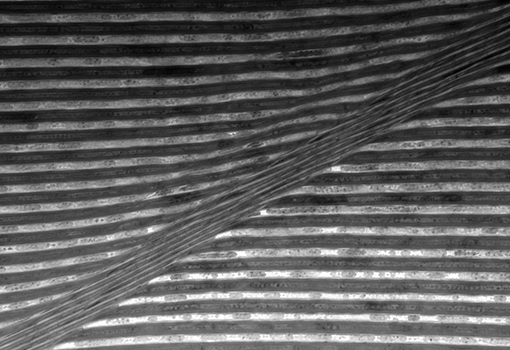
Caption: Depiction of a bimetallic nanolaminate being deformed under a force and responding by forming a band. These nanolaminates comprise stacks of crystalline layers each of only tens of nanometers in thickness. Research involves changing the interface between the layers to make them simultaneously strong and tough.

Materials PhD candidate Nicolas Fuchs-Lynch will conduct thesis research at a Department of Energy national laboratory.