
When John Bowers arrived at UC Santa Barbara in 1987, fiber-optic communications research was still relatively young. He had watched the field begin to take shape at Bell Laboratories, when early optical systems transmitted data at rates that would be considered unimaginably slow today.
Nearly four decades later, technologies that Bowers helped develop are an essential part of the infrastructure moving enormous amounts of data among computers, data centers, and communications networks around the world.
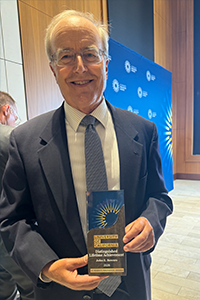
In recognition of Bowers, the Fred Kavli Distinguished Professor Emeritus of materials and electrical and computer engineering, and his sustained impact on the world, the University of California has recognized Bowers with the 2026 Distinguished Lifetime Achievement Award for Innovation.
Presented as part of the inaugural UC Regents Innovation Awards, the honor recognizes researchers whose careers have produced multiple innovations with lasting societal impact while inspiring future inventors and entrepreneurs.
“The Board is honored to support University of California innovators who turn discoveries into new jobs, economic growth, and lasting societal benefit across the country,” said UC Board of Regents Chair Maria Anguiano.
In Bowers’s case, that description fits a career spent not only inventing technologies, but finding ways to put them to work.
“I’m very honored to receive the Distinguished Career Award from UC Regents Innovation Summit,” Bowers said. “I’ve been successful because I’ve been a part of such a strong community at UCSB. The leadership and my colleagues here have been so supportive of all those efforts, whether it be teaching or research or entrepreneurship.”
Umesh Mishra, dean of The Robert Mehrabian College of Engineering at UCSB, said that Bowers’s influence extends well beyond any individual invention.
“John has an extraordinary ability to see not only what is scientifically possible, but what it will take for an idea to have real impact,” Mishra said. “His contributions span fundamental research, transformative technologies, successful companies, and generations of students and colleagues whom he has helped become innovators themselves. That is an exceptional legacy, and this recognition is richly deserved.”
The UC recognition adds to a long list of honors for Bowers. He was elected to the National Academy of Engineering in 2005, and he is also a member of the National Academy of Inventors and a fellow of IEE, Optica, the American Physical Society, and the American Association for the Advance of Science. His major awards include the IEEE Photonics Award, the IEEE Jun-ichi Nishizawa Medal, and Optica’s John Tyndall Award and Nick Holonyak, Jr. Award.
Making Fiber Optic Data Move Faster
Bowers began his career at Bell Labs just as fiber optics was emerging as a new way to carry information.
“The first systems were just fifty megabits per second,” he recalled.
His early work pushed optical systems to higher speeds and helped advance wavelength-division multiplexing, which allows multiple streams of information to travel through a single optical fiber. After arriving at UCSB, he expanded into high-speed photonic devices, including lasers, modulators, detectors, and vertical-cavity surface-emitting lasers, or VCSELs.
UCSB had already established unusual strength in compound semiconductors through faculty including Nobel laureate Herb Kroemer and semiconductor-processing pioneer Evelyn Hu. The environment allowed researchers to grow new materials, fabricate devices, and test them within the same community. That ecosystem helped UCSB researchers establish world-leading VCSEL performance in the early 1990s while advancing tunable lasers, transistors, and photonic integrated circuits.
Bowers eventually turned his attention to solving one of the central challenges of photonics by bringing the light-generating advantages of compound semiconductors onto silicon.
Silicon is ideal for electronics but poor at producing light. Bowers and his students helped develop a heterogeneous integration approach that bonds light-emitting III-V semiconductor materials to silicon, allowing lasers and conventional silicon electronics to coexist on an integrated platform.
The approach helped overcome a major obstacle to silicon photonics and has since been commercialized by companies including Intel and Juniper Networks, as well as UCSB spinoffs. The technology is increasingly important for moving large amounts of data efficiently in data centers and artificial-intelligence systems.
UC credits Bowers with integrating laser technology directly onto silicon chips and helping increase fiber-optic data transmission rates by a factor of one thousand.
“We are particularly good at materials,” Bowers said of UCSB. “And this focus on growth of novel materials enables new devices.”
Combining III-V materials with silicon, he added, enables the integration of photonics and electronics, a capability increasingly important for data centers and emerging co-packaged optics.
From Research to Companies
For Bowers, demonstrating a technology in the laboratory was rarely the endpoint.
He has helped launch numerous companies, often alongside students, to move university discoveries into commercial use. Bowers estimated that he has started or co-founded eight startups.
Terabit Technology developed high-speed optical receivers and was acquired by Ciena. Aerius Photonics commercialized advanced laser and detector technologies before its acquisition by FLIR Systems.
Bowers and UCSB professor Daniel Blumenthal also co-founded CALIENT Technologies around optical-switching technology developed at UCSB. The company builds high-density optical circuit switches for communications networks and data centers.
Aurrion provides perhaps the clearest link between Bowers’s university research and today’s silicon photonics industry.
Co-founded in 2008 by Bowers and former UCSB student Alexander Fang, Aurrion developed technology for integrating optical and electronic components on silicon while using compound semiconductor materials to generate light. Juniper Networks acquired the company in 2016 to strengthen its capabilities in high-speed optical networking.
Recent ventures have carried that work into emerging applications. Nexus Photonics, co-founded with postdoctoral researcher Tin Komljenovic, develops integrated photonics for quantum computing, communications, and sensing, and was recently acquired by IONQ. Quintessent, co-founded by Bowers and former student Alan Liu, is developing optical connectivity technology for AI infrastructure. Most recently, Bowers, his former student Chen Shang, and UCSB electrical and computer engineering professor Galan Moody, co-founded Qudara, a company developing photonics-based quantum computers and networks.
Building the Next Generation
Over time, Bowers said that his definition of successful innovation has evolved.
“My goal used to be to start companies to commercialize the technology that came out of my research lab,” he said. During the past twenty-five years, however, his focus has increasingly shifted toward helping other people succeed, first by encouraging graduate students and postdoctoral researchers to commercialize their work and more recently by advising students and faculty members interested in entrepreneurship.
Bowers also helped establish UCSB’s Center for Entrepreneurship and Engineering Management, a precursor to today’s Department of Technology Management, and taught entrepreneurship for more than two decades. He also served as founding director of the university’s Institute for Energy Efficiency.
His influence also can be measured in the researchers who followed him.
Richard Mirin, a former Bowers doctoral student who returned to UCSB as a professor after a career at the National Institute of Standards and Technology, described the challenge of succeeding his former adviser after Bowers retired.
“John’s a legend,” Mirin said, adding that Bowers remains a mentor even in retirement. Their research overlaps in semiconductor lasers, wafer bonding, and integrated photonics, areas that continue to advance at UCSB.
For Bowers, that continuity is central to why he chose an academic career.
“I came to UCSB because I wanted to help students be successful,” he said. “You get to a point in your career where you’ve written lots of papers and patents and gotten some awards, and the goal was to really help students mature from inexperienced, wide-eyed students to really first-rate technologists.”
For a career defined by making data travel faster, Bowers’s most enduring measure of progress may be the people carrying the work forward.
“That’s what makes me excited,” he said, “and that’s why I like helping them succeed commercially in startups or in established companies.”
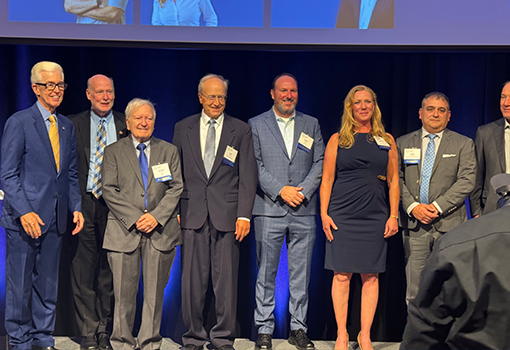

Distinguished Professor Emeritus John Bowers was recognized by the University of California with its 2026 Distinguished Lifetime Achievement Award for Innovation.