
The facility will accelerate technology translation and national economic growth.
College of Engineering News

UC Santa Barbara has entered into a long-term lease for a 105,000-square-foot-facility within Goleta’s tech corridor and adjacent to campus.
Sep 08, 2025

State-of-the-art research facilities at UC Santa Barbara and UCLA support impactful discoveries in materials science through the BioPACIFIC MIP.
Aug 25, 2025
The facility connects fundamental research with industry needs, strengthening U.S. leadership in biomaterials innovation.

Team AXOLYFT (left to right): Justin Do (ME), Sawyer Trumbly (ME), Dylan Xie (ME), Anna Hillen (ME)
Jul 15, 2025
After a year of development, they demonstrate their cutting-edge projects in AI, aerospace, robotics, and more.

California Assemblymember Gregg Hart speaks during the afternoon session to a crowd that included (front row, from left) CNSI Executive Director of Scientific Initiatives and Innovation Tal Margalith, CNSI Director Craig Hawker, Chancellor Henry Yang, Executive Vice Chancellor David Marshall, and Umesh Mishra, dean of The Robert Mehrabian College of Engineering. Photograph by Jeff Liang.
Jul 15, 2025
Representatives from eleven companies that began in the Incubator shared their stories.

Microchips produced in the Nanofab aren't yet ready to be used in prototypes and system demonstrations; they need to be enclosed in protective casings, have wires attached, and be attached to circuit boards, all of which is known as "packaging" the chips. (Image courtesy of Daniel Blumenthal, professor of electrical and computer engineering)
May 28, 2025
UC Santa Barbara receives key funding for facility to unlock the full potential of the region’s semiconductor ecosystem.

Raspberry Pi fans (far left and right): Rich Wolski and Chandra Krintz with (from left) fourth-year PhD student Animesh Dangwal and undergraduate student researchers Emily Zheng, Karen Yuan, Shruthi Santhosh Unnithan, and Ria Sing. Photograph by James Badham
Apr 09, 2025
The world’s biggest assembly of Raspberry Pi computers comes to UCSB.
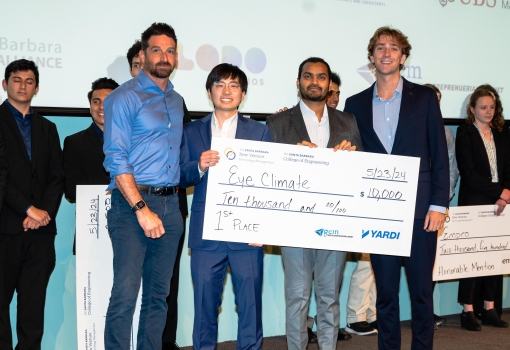
Jason Rottman (far left), a representative from NVC premiere sponsor Yardi Systems congratulates EyeClimate, the 2024 New Venture Competition Finals champions (from second to left) Bowen Zhang, PhD student; Max Gordon, undergraduate student; and Satish Kumar, PhD student
May 24, 2024
EyeClimate takes on climate change to win 25th UCSB New Venture Competition.
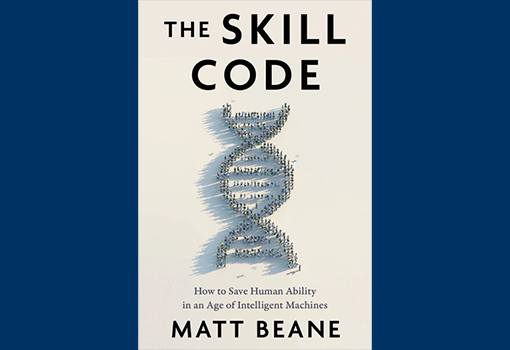
The Skill Code: How to Save Human Ability in an Age of Intelligent Machines, a book written by technology management assistant professor Matt Beane, discusses how to protect skills in a world filled with AI and robots.
Apr 29, 2024
UCSB assistant professor Matt Beane writes a book on how to protect skills in a world filled with AI and robots.
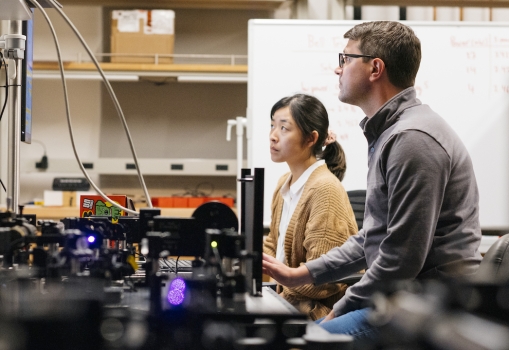
Electrical and computer engineering professor Galan Moody (right) says UCSB students like Amalu Shimamura (left), a PhD student in his research group, will benefit greatly from the partnership.
Nov 29, 2023
UCSB will work with Xanadu to co-create custom resources for students and develop training materials.
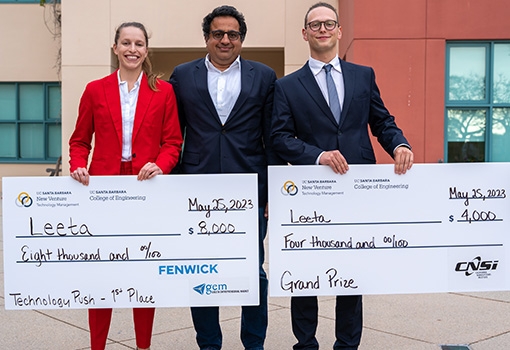
Leeta team members, Kira Wyckoff (left)) and Linus Kautzsch (far right), with their advisor Ram Seshadri
Jun 01, 2023
The team received $12,000 in prizes for their novel manufacturing process to produce high-demand battery materials.
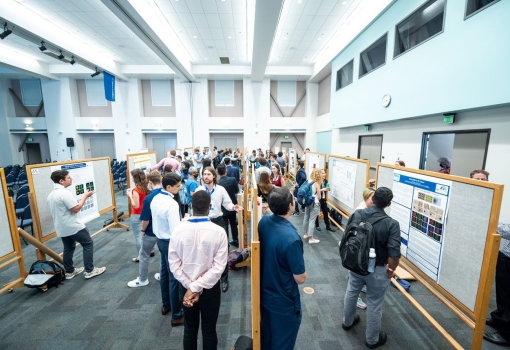
Students, faculty, and industry came together for the three-day event to exchange information and forge research collaborations.
Aug 12, 2022
The three-day symposium united students, faculty, and industry members to share their work and forge research collaborations.
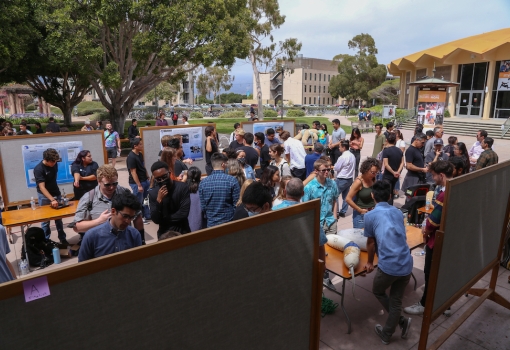
Fifteen capstone teams showcased their projects during the Capstone Design Expo.
Jun 15, 2022
Judges award capstone teams for ingenuity and product development.
- ‹ previous
- 2 of 4
- next ›